The AI Long Jump Coach That Reads Every Frame
A coach watches your jump once, at full speed, from one angle. Athletics AI watches all of it — every frame, every joint — then tells you the two things worth fixing before your next attempt.
It will not replace your coach. It is the measuring half of coaching, in your pocket, on a Tuesday night when nobody is at the track.


What an AI Long Jump Coach Actually Does
A long jump lasts about six seconds. The part that decides your distance — the penultimate step, the plant, the drive off the board — takes under half a second, and your takeoff foot is on the ground for roughly a tenth of it.
Nobody resolves that in real time. A good coach watches the shape of the jump and infers the rest from thousands of jumps of experience. That inference is worth a lot, and it is also the thing that varies with fatigue, viewing angle, and how many athletes are on the runway that afternoon.
An AI long jump coach flips the problem. It does not watch the jump. It measures it.
Pose estimation places your joints in every frame, so takeoff angle, lead knee height, hip extension and the reach of your feet at landing stop being impressions and become numbers. Then those numbers get turned back into the only thing you can use on a runway: a cue.
That last step is the whole point. A number on its own never changed a jump. Your takeoff angle is 26 degrees is a fact. You are jumping up instead of out — drive the knee forward instead of lifting it is coaching.
One Strength, Two Cues
Most video tools fail the same way. They hand you forty metrics and leave you to work out which three matter. That is not coaching, it is a spreadsheet with a video attached.
Every analysis comes back in the same shape: one thing you did well, two things to focus on. Two, because nobody holds more than two thoughts on a runway. The strength comes first, because technique work that only ever lists faults stops working on athletes very quickly.
Each cue arrives with the drill that fixes it and the reps to do, so the next session has something in it beyond the instruction to try harder.
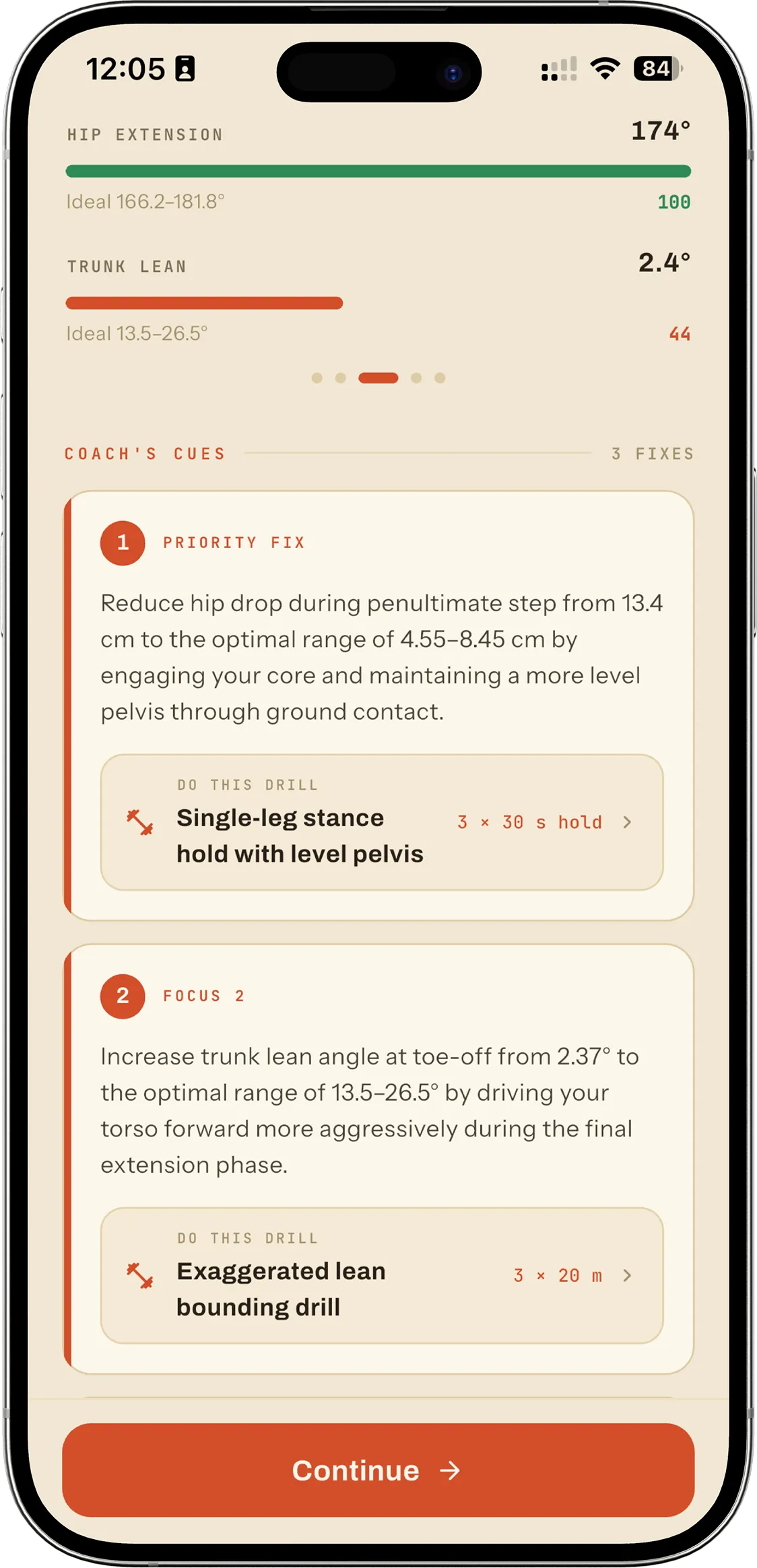
Your penultimate step is genuinely good — you lowered the hips and kept the speed. That is the hardest part of the jump to learn and you already have it.
- 01
Takeoff angle is 25.8°, a little steep. You are turning speed into height you cannot use. Cue: run through the board, not off it.
- 02
Lead knee stops below hip height. Drill: box jumps for knee drive, two sets of five, before your next jump session.
The worked example above is illustrative, not a real athlete's data. On the takeoff-angle point specifically, see why the optimal angle is 18–22°, not 45°.
AI Coach, Human Coach, or Just Your Phone?
These are not competing products. They are three different things that each see part of the jump, and the honest answer is that the best setup uses all three.
| What you get | Human coach | Phone, no analysis | Athletics AI |
|---|---|---|---|
| Sees the tenth of a second on the board | By eye, at full speed | Only if you slow it down yourself | Frame by frame, every rep |
| Gives you numbers | Rarely — mostly experience | No | Takeoff angle, knee drive, hip extension, landing |
| Remembers every attempt | The important ones | No | All of them, with the metrics attached |
| Reads the room | Yes — mood, fatigue, competition nerves | No | No |
| Available Tuesday at 9pm | Usually not | Yes | Yes |
Where It Fits in Your Week
The comparison above is only useful if the three of them actually stack. Here is what that looks like across one training week.
The Session Nobody Watches
You are at the track on your own, or your coach is on the far runway with the sprinters. Film three attempts and analyse them before you drive home. The session that used to produce a feeling now produces four numbers.
The Session With Your Coach
Arrive with "my takeoff angle has sat at 26 degrees for three weeks" rather than "it felt short". A coach can act on the first sentence in a minute. The second one costs them half the session just to diagnose.
Did the Cue Actually Work?
You have been drilling one fix for a month. Every attempt is stored with its metrics, so the answer is a line you can look at — not an argument with your own memory about whether it feels better.
What It Cannot Do
It measures what the camera can see. Film from an angle and the numbers degrade, because a 2D pose estimate cannot recover what is not in the frame. Side-on to the runway with the takeoff fully in shot is reliable; from behind, it is not.
It does not know that you tightened up because it was a competition, that you are three weeks back from an ankle injury, or that the run-up felt wrong from the second stride. Your coach knows all of that, and none of it is in the video.
It will not write your training programme either. It tells you what your technique did on a given attempt and what to work on next. Turning that into a season is still a human job.
Questions Athletes Ask
How do I get it?
Download it on the App Store, film one jump side-on, and upload it. Your first analysis comes back the same session. (Android is coming soon.)
What does it cost?
The annual plan opens with a free 3-day trial, so you can film a jump and read the coaching before you pay anything — it's $34.99 a year after that. The monthly plan has no trial and is $9.99 a month from day one. Cancel anytime.
Can an AI long jump coach replace a real coach?
No, and it should not try. It replaces the part of coaching that is measurement — angles, phases, consistency across reps. It does not replace programme design, competition management, or knowing that you jump badly when you are anxious. Think of it as the analytical half of a coach that happens to be available every day.
What does the coaching feedback actually look like?
One strength and two focus cues per attempt, in plain coaching language, plus specific drills tied to what the numbers showed. Not a dashboard of forty metrics you have to interpret yourself.
Do I need special equipment?
A phone and a jump. No markers, sensors, or force plates. Film side-on to the runway with the takeoff fully in frame and that is enough.
Does it work for beginners?
Beginners often gain the most, because the errors are larger and the cues are more actionable. The feedback is written in plain language rather than biomechanics jargon, so a fourteen-year-old can act on it without a coach translating.
More on Long Jump Technique
Long Jump Technique Analyzer
Exactly what gets measured, how the pipeline works, and how to film a clip that analyses well.
The Optimal Takeoff Angle Is Not 45°
Why the physics-classroom answer is wrong, and the number elite jumpers actually hit.
Fix Your Run-Up and Stop Fouling
Fouling is almost never a board problem. Build a repeatable approach in three sessions.
8 Long Jump Drills Every Coach Uses
What each drill actually fixes, and how to sequence them across a training week.
Put a Coach's Eye on Every Jump
Film one attempt, upload it, and find out what your takeoff is really doing. Starts with a free 3-day trial on the annual plan — cancel before it ends and you pay nothing.